%20(1200%20%C3%97%20430%20px)(1).png)
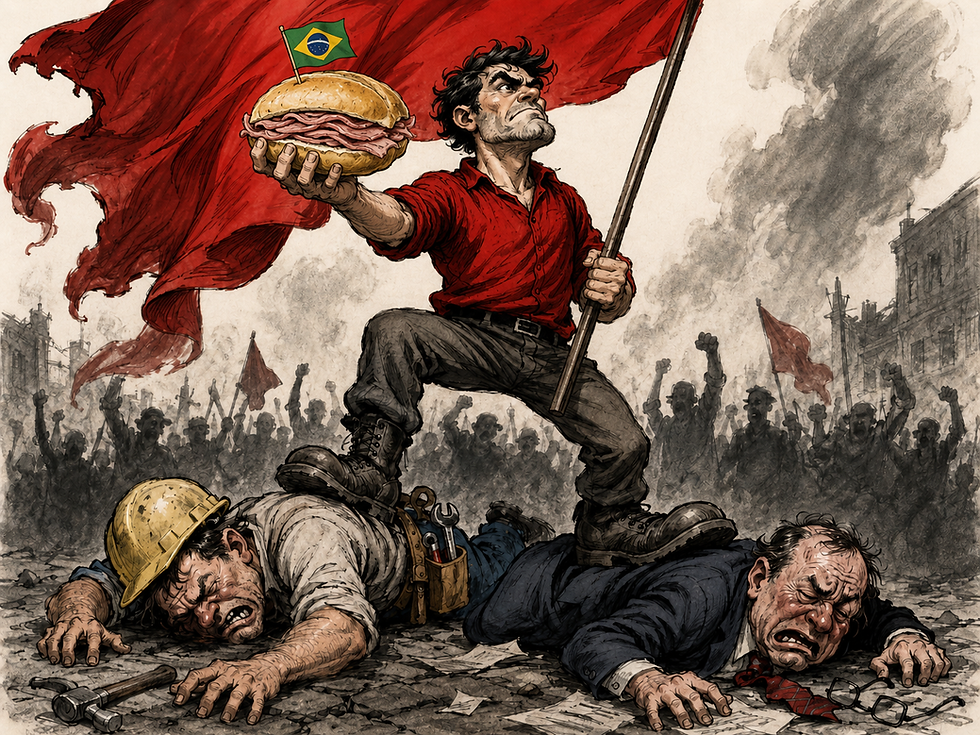
Bolivia: Leftist terrorism fueled by Brazilian mortadella? Our future after Lula's defeat?
- Jorge Augusto Derviche Casagrande
- May 17
- 5 min read

Protests! Breakage, vandalism, attacks on the police, false narratives exploiting the legacy of poor education and lack of logic from generations of leftist governments. All this against a law that favored the productive sector in Bolivia when it came to requesting financing.
Anyone who lives in Brazil knows that without mortadella, there are no protests. It doesn't seem to be any different in Bolivia, but the worrying question is: to what extent is the Brazilian government involved, and if that government is defeated, are there real chances of it replicating Evo Morales' tactics?
Bolivia is currently experiencing physical and institutional vandalism directed against the productive sector by those who lost at the polls. The formal trigger was the reaction to Law 1720, a law that would allow small agricultural properties to be transformed into assets suitable for use as collateral for loans, removing some of their traditional protection against asset seizure. This measure was maliciously and premeditatedly interpreted by peasant, indigenous, and union sectors as a threat to the legal security of land ownership. This is typical; the left loves to exploit highly vulnerable groups, whose vulnerability it itself creates through malice or sheer incompetence.
In order to preserve the productive sector, which was severely affected by blockades and vandalism, the Bolivian government backed down, revoked the law, and reopened discussions aimed at greater participation and clarification for all sectors (including the education of the left's manipulated masses). Even so, the protests did not cease. On the contrary, they intensified. This is not surprising, because the protest is not about the law, but about Evo Morales seizing power without votes or moral authority.
The correct question at the moment seems to be: are we still facing legitimate social protest, or have we already entered the realm of organized political coercion?
There is an essential difference between popular demonstration and systematic blockade of national life. The former is a democratic expression. The latter, when employed to impede circulation, create shortages in cities, constrain institutions, and force the fall of a newly elected government, approaches insurrectionary tactics. It is a tactic of civil war. And war is expensive; it needs to be financed. It is not merely about making demands; it is about imposing, through collective force, what was not obtained through elections.
For decades, Bolivia was a political laboratory for a statist, unionized model deeply dependent on mass mobilization as an instrument of power. The loss of hegemony of the Bolivian left, coupled with the election of a government with a discourse of economic reforms, creates a natural environment of resistance from groups that have always orbited the State and extracted influence, positions, subsidies, favorable regulations, and veto power from it.
Evo Morales, widely linked to narco-terrorism, emerges in this context as a central, shadowy figure. Bolivian authorities accuse opposition leaders, including Morales, of inciting instability; Morales, in turn, has expressed support for the protests and maintains that he is the target of political persecution.
But perhaps the most relevant point is not just who appears on the front lines. It's who finances it, who orchestrates it, and who benefits from it.
Let's inquire: Who sustains the logistics of prolonged blockades? Who pays for travel, food, fuel, communication, equipment, lawyers, union structure, and maintaining mass protests in the streets? Is there internal funding? Is there support from economic sectors opposed to the reforms? Is there foreign money? Are there transnational political networks interested in preventing Bolivia from ceasing to be an ideological hub of the Latin American left?
The hypothesis of external financing cannot be asserted without proof. It would be legally irresponsible to impute, without documents, the direct participation of foreign governments, companies, or operators. But it would also be extreme analytical naiveté to exclude this possibility in a continent where parties, unions, NGOs, social movements, and paramilitary structures historically operate in regional networks of influence. Especially since this is a kind of "mortadella" movement that we know well in Brazil.
We inquired further: Are there Brazilian interests at stake? Are there political, business, or ideological sectors in Brazil interested in preserving Bolivia within a specific geopolitical orbit? Are there indirect channels of support? Are there foundations, intermediaries, private operators, or front entities financing political mobilization outside the country? Does the Brazilian government have any involvement, even informal, in this environment? Or is it simply a matter of ideological convergence without direct funding?
What is known is that the Bolivian crisis is occurring at a sensitive moment for all of Latin America. The continental left is facing profound wear and tear. Its discourse of social justice increasingly coexists with practical results of impoverishment, state capture, inflation, dependence on subsidies, institutional erosion, and hostility towards free enterprise. When it loses votes, it tends to resort to street protests. When it loses control of the state, it tries to make the country ungovernable. When it loses the narrative, it accuses its opponent of destroying popular rights.
Bolivia may be demonstrating a pattern that is of direct interest to Brazil.
If a right-wing government wins in Brazil and attempts to implement structural reforms, reduce the size of the state, review subsidies, privatize, open the economy, and confront public or union corporations, it is reasonable to imagine a similar terrorist reaction, likely financed with foreign capital. Blockades, occupations, political strikes, coordinated judicialization, international pressure, disinformation campaigns, accusations of authoritarianism, and attempts to undermine the government before it produces results.
The Bolivian experience, therefore, is not just Bolivian. It is a warning.
The problem is not the right to protest. The problem lies in turning protest into a weapon of institutional sabotage and holding the productive sector hostage to war. Democracy is not just the right to take to the streets. It is also the duty to respect the results of the polls, the authority of the elected government, and the legal mechanisms of opposition. When organized movements attempt to replace elections with collective intimidation, they cease to act as democratic actors and begin to operate as a coercive force.
The final question is the most uncomfortable: is what is happening in Bolivia a spontaneous social upheaval or a rehearsal for a power grab through extra-institutional means?
The answer still depends on proof. But the sequence of events justifies suspicion, surveillance, and investigation. The repeal of the law that allegedly sparked the protests did not pacify the country. The demands broadened. The president's resignation became the rallying cry. Organized groups maintained pressure on strategic infrastructure. The crisis ceased to be merely agrarian; it became political.
And when a specific agenda quickly transforms into a demand for the overthrow of a government, the question ceases to be "what is the demand?" and becomes "what is the power project behind it?".
Bolivia may be facing its best opportunity in decades to break with the cycle of statism, managed poverty, and union capture of the state. But precisely for this reason, it faces resistance. No power system consolidated over so many years disappears without a reaction. And, in Latin America, the reaction rarely limits itself to parliamentary debate.
It's an ongoing battle, but we have faith that the productive sector will prosper and the narco-leftist disease will be cured.
Comments